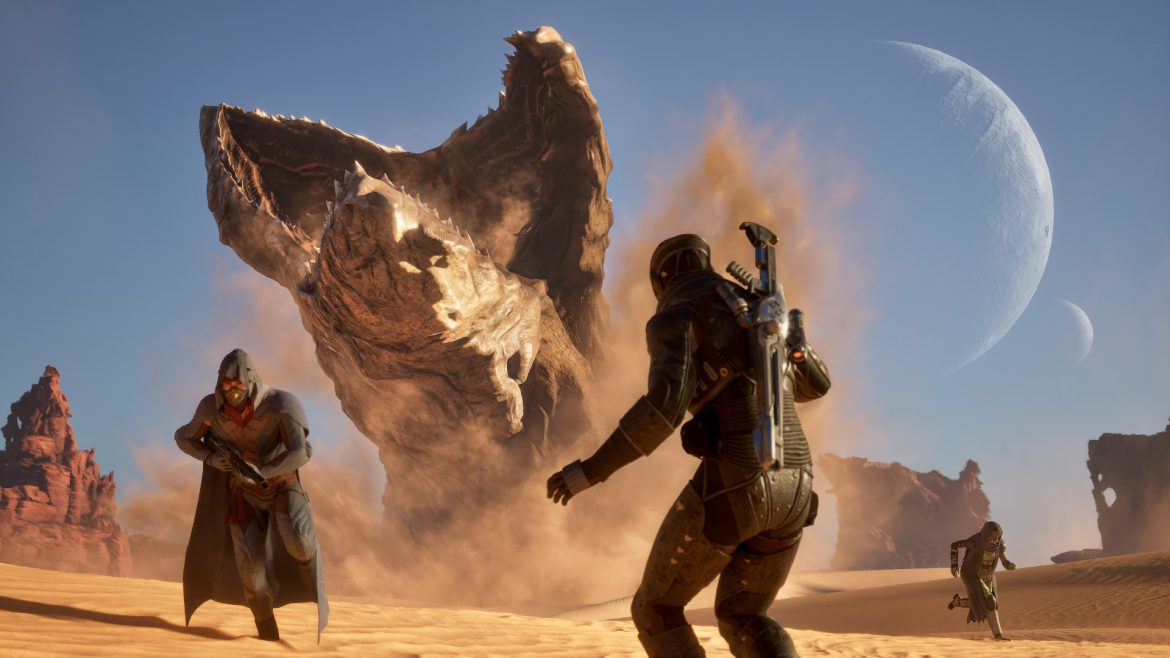
With a big Chapter 2 update and paid DLC on the way, survival MMO Dune: Awakening is moving on from the primordial launch phase and really starting to walk. As the game and its community mature, developer Funcom suggests it’s seen an uptick of players leaning more into the survival aspects of the game, which is a space it’s open to exploring.
Dune: Awakening production director Ole Andreas Hayley spoke to GamesRadar+ at Gamescom around the big update reveal. We discussed the current state of the game’s world and where it’s headed, and how its curious mix of genres comes into play.
“One of the best descriptions of Dune: Awakening that I’ve heard is, you have this survival as the core aspect,” Hayley begins. “It’s like a Dune survival RPG in a way. It has such strong RPG elements. And the MMO part is kind of there to support some of that feeling of being in a universe that’s alive, that has some sense of politics and intrigue and factions that are working together and against each other. But for us, it’s been really fun to see how the survival RPG thing is kind of getting a foothold, in a way, in how people love our game. So I think for us, exploring that avenue more is quite interesting.”
You may like
-
Dune: Awakening devs say “you don’t have to engage in PvP” in the MMO and the Deep Desert is here to stay, but more PvE is coming
-
Dune: Awakening devs promise “a bunch of changes” as the survival MMO’s PvP and endgame content come under fire over loot, balance concerns, and more: “Total mess”
-
Dune: Awakening will get a roadmap “once the craziness of launch has died down,” and the only time the survival MMO will charge for new content is “because it’s something big”
Supporting both types of experiences and audiences within Dune: Awakening might require a mix of solo and group content, for instance. Hayley also touched on how to balance the PvE and PvP experiences, and where Funcom is happy to let players write their own stories and rules through community interactions and roleplaying, and where the devs might have to step in for the health of the game. The ornithopter griefing comes to mind. Where does player behavior add to the experience, and when can it hurt it?
“So fundamentally, the game needs to feel fair,” Hayley argues. “If you’re on the aggressor side, or the victim side, it needs to feel fair, like you had a choice. So if there is a mechanic in the game that allows for something like this, there needs to be either counterplay for you to handle it, or there needs to be a way for you to get away from that situation. And that’s the injection point for us. We want to give the players the tools to have those moments, but then if they don’t have the tools to deal with those moments, that’s where we need to bring those in.”
An MMO is a community of communities, and satisfying the PvE and PvP folks, as well as defining the two experiences, is especially “kind of tricky to nail down,” Hayley says.
“We had an intention when we released the game that didn’t pan out as we hoped,” he reflects. “There were some friction points there, especially in the beginning for the PvE players, because they felt locked out of some of the progression that was hidden or locked behind PvP. So we did some changes to that to increase the PvE area in the Deep Desert, for example. And now we’ve recently done a change to make some of those resources, or actually most of those resources, available in the starting area of the Deep Desert, which is PvE. So it’s been interesting to try and navigate that.”